
Fort Collins, CO Cost of Living in 2026: Rent, Homes, Taxes
Fort Collins is the county seat and most populous municipality of Larimer County, on the Cache la Poudre River about 60 miles north of the Colorado State Capitol in Denver, according to Wikipedia. The city counted 169,705 residents in the Census Bureau’s 2019 to 2023 American Community Survey (ACS) 5-year estimates. It is home to Colorado State University, whose enrollment was approximately 34,000 students in 2024, and to UCHealth Poudre Valley Hospital.
The short version for someone leaving a large metro: rents sit close to the regional fair market rent, home prices are high relative to local incomes, and the local sales tax is higher than the state rate alone suggests. The sections below put numbers on each of those, with the source linked next to every figure.
Rent in Fort Collins: Census medians and HUD’s 2026 fair market rents
The median gross rent in Fort Collins was $1,661 a month in the 2019 to 2023 ACS 5-year estimates. Against the city’s median household income of $83,598 from the same survey, that rent works out to 23.8% of income ($1,661 × 12 ÷ $83,598).
The ACS figure averages five years of responses, so it lags current asking rents. A more recent benchmark is the U.S. Department of Housing and Urban Development’s FY2026 Fair Market Rents for the Fort Collins-Loveland, CO MSA:
| Unit size | FY2026 FMR | FY2025 FMR | Income for rent at 30% |
|---|---|---|---|
| Efficiency | $1,509 | $1,434 | $60,360 |
| One bedroom | $1,537 | $1,442 | $61,480 |
| Two bedrooms | $1,732 | $1,695 | $69,280 |
| Three bedrooms | $2,385 | $2,375 | $95,400 |
| Four bedrooms | $2,540 | $2,526 | $101,600 |
The last column applies the familiar guideline of spending no more than 30% of gross income on rent: monthly FMR × 12 ÷ 0.30. For the two-bedroom figure, $1,732 × 12 ÷ 0.30 = $69,280 a year. At the Census median rent of $1,661, the same calculation gives $66,440. Both are below the city’s $83,598 median household income, but the median describes a household, and many one-earner households will sit below it.
Year over year, HUD’s two-bedroom FMR for the metro rose from $1,695 in FY2025 to $1,732 in FY2026, an increase of 2.2%. The one-bedroom FMR rose from $1,442 to $1,537, or 6.6% (HUD FY2026 FMR documentation).
Buying a home at 6.6 times the median income
Ownership is where Fort Collins gets expensive. The median value of owner-occupied homes was $548,400 in the 2019 to 2023 ACS, which is 6.6 times the median household income of $83,598 ($548,400 ÷ $83,598 = 6.56). Just over half of occupied homes, 52.1% (36,885 of 70,782), were owner-occupied in the same survey.
To translate that into a monthly payment, take the Freddie Mac Primary Mortgage Market Survey average for a 30-year fixed-rate mortgage, 7.03% as of September 24, 2026. A buyer putting 20% down ($109,680) on a $548,400 home would borrow $438,720. At 7.03% over 30 years, principal and interest alone come to about $2,928 a month, before property taxes, homeowners insurance or any HOA dues. That is $1,267 more per month than the median gross rent of $1,661, and $35,132 a year in principal and interest equals 42.0% of the $83,598 median household income.
Two cautions on those numbers. First, $548,400 is a five-year survey estimate, not a current sale price. Second, Freddie Mac reports a U.S. weekly average; individual quotes vary with credit, down payment and points. The same survey showed the 30-year rate at 6.30% a year earlier, so the payment math shifts noticeably with the rate cycle (Freddie Mac PMMS).
Colorado’s flat income tax and an 8.30% sales tax
Colorado taxes individual income as a percentage of Colorado taxable income. The Colorado Department of Revenue lists the rate as 4.4% for tax year 2025, after 4.25% for 2024. Because the rate has moved from year to year, check the department’s table for the year you will file.
Sales tax stacks three layers in Fort Collins. The City of Fort Collins sales tax page lists a combined rate of 8.30%: 4.35% for the City, 1.05% for Larimer County and 2.90% for the State of Colorado. The county’s share rose to 1.05% effective January 1, 2026, according to Larimer County. On a $1,000 purchase of taxable goods, 8.30% adds $83.
- The City also applies a 2.25% tax on food for home consumption (City of Fort Collins).
- Lodging carries an additional 3.00% City lodging tax, for a total accommodations tax of 11.30% (City of Fort Collins), which matters mostly for visitors you host.
Getting around: fare-free Transfort, Bustang to Denver and gas prices
The city bus system, Transfort, describes riding as “currently fare-free” on its website (September 2026 archived copy). Its spine is MAX, a bus rapid transit line that runs on the Mason Corridor parallel to College Avenue from downtown to a transit center just south of Harmony Road, with an end-to-end trip of about 15 minutes, according to Wikipedia. The same article lists the FLEX regional route to Loveland, Berthoud, Longmont and Boulder, and the Poudre Express, run by Greeley-Evans Transit, to Windsor and Greeley.
For Denver trips without a car, the state’s Bustang North Line stops at the Fort Collins Downtown Transit Center (250 N. Mason St.) and the Harmony Transfer Center at I-25 Exit 265. A one-way single-ride ticket from the downtown transit center to Denver Union Station is $10.00, with $7.50 for seniors and riders with disabilities and $5.00 for children 2 to 11 (Bustang North Line). Denver International Airport is about 70 miles to the south (Wikipedia).
Most households will still drive. On September 27, 2026, AAA put the average price of regular gasoline in the Fort Collins-Loveland metro at $4.207 a gallon, against $4.215 for Colorado and $4.480 nationally (AAA Colorado gas prices). A year earlier the metro average was $3.035, so pump prices are up 38.6% year over year ($4.207 versus $3.035).
Healthcare anchored by Poudre Valley Hospital
UCHealth Poudre Valley Hospital, at 1024 S. Lemay Avenue, describes itself as a 300-bed regional medical center serving northern Colorado, southern Wyoming and western Nebraska. Its services listed on the hospital page (2025 archived copy) include emergency care, a birth center, a neonatal intensive care unit, orthopedics, heart and vascular care, and trauma and acute care surgery.
Healthcare is also one of the city’s largest paychecks. The City’s 2024 Annual Comprehensive Financial Report, as summarized on Wikipedia, ranks the University of Colorado Hospital Authority as the second-largest employer in Fort Collins with 5,900 employees, and Orthopaedic & Spine Center of the Rockies tenth with 700.
A university and hospital economy
Public institutions dominate the employer list. From the same 2024 financial report, via Wikipedia:
| Rank | Employer | Employees |
|---|---|---|
| 1 | Colorado State University | 8,850 |
| 2 | University of Colorado Hospital Authority | 5,900 |
| 3 | Poudre R-1 School District | 4,600 |
| 4 | City of Fort Collins | 2,550 |
| 5 | Larimer County | 2,550 |
| 6 | Woodward, Inc. | 1,350 |
| 7 | Broadcom Inc. | 1,050 |
The top three alone account for 19,350 jobs (8,850 + 5,900 + 4,600). The university also shapes the population: the median age is 30.6 years and 59.9% of adults 25 and older hold at least a bachelor’s degree (2019 to 2023 ACS). Colorado State is an R1 research university that spent $498.1 million on research and development in fiscal year 2023 (Wikipedia).
Read the city’s ACS poverty rate of 16.0% and unemployment rate of 5.2% (2019 to 2023 ACS) with that college town profile in mind. They are city-wide figures for all residents, so they say little on their own about the job market for a mid-career professional.
Fort Collins vs. Loveland and Greeley on the same Census measures
Loveland shares the Fort Collins-Loveland metro area with Fort Collins in HUD‘s definition, and Greeley is linked by the Poudre Express bus (Wikipedia). Here are the three cities side by side, all from the 2019 to 2023 ACS 5-year estimates:
| Measure | Fort Collins | Loveland | Greeley |
|---|---|---|---|
| Population | 169,705 | 77,350 | 109,421 |
| Median age | 30.6 | 40.8 | 32.5 |
| Median household income | $83,598 | $82,592 | $68,650 |
| Median home value | $548,400 | $453,100 | $369,600 |
| Home value ÷ income | 6.6 | 5.5 | 5.4 |
| Median gross rent | $1,661 | $1,683 | $1,333 |
| Rent as share of income | 23.8% | 24.5% | 23.3% |
| Owner-occupied share | 52.1% | 61.8% | 60.6% |
| Bachelor’s degree or higher | 59.9% | 39.1% | 26.7% |
The comparison mostly tells a home price story. Loveland’s median household income is almost the same as Fort Collins’ ($82,592 versus $83,598), yet its median home value is $95,300 lower (17.4% less). Greeley’s median home value is $178,800 lower than Fort Collins’ (32.6% less), with a lower median income as well. Rent is a different picture: Loveland’s median gross rent of $1,683 is slightly above Fort Collins’ $1,661, and Greeley’s is $328 lower at $1,333.
Tradeoffs to weigh before moving
- Renting is the easier entry. The Census median rent of $1,661 takes 23.8% of the median household income, while principal and interest on a median-value home at 7.03% would take 42.0% (figures above, from the ACS and Freddie Mac).
- Car-light is possible on some corridors. Local buses are fare-free (Transfort), and a $10.00 Bustang ticket reaches Denver Union Station (Bustang). Outside those lines, plan on driving.
- Watch taxes on everyday spending. The combined 8.30% sales rate (City of Fort Collins) is paid on most purchases, on top of a 4.4% state income tax for 2025 (Colorado DOR).
- A college town age profile. A median age of 30.6 versus 40.8 in Loveland (ACS) suggests different neighborhoods, rental stock and daily rhythms. Which one suits you is a personal call, not something the data settles.
- Nearby cities trade price for distance. Loveland and Greeley both show lower median home values in the same survey. The cost is a commute or a transit ride if your job is in Fort Collins.
Frequently Asked Questions
What is the median rent in Fort Collins, CO?
How much income do you need to rent in Fort Collins?
What is the sales tax rate in Fort Collins?
Is the bus free in Fort Collins?
Is Fort Collins more expensive than Loveland or Greeley?
How this guide was made. Figures come from the sources named next to each number. A first draft was written with the help of an AI language model; every place name, price, date and claim was then checked against primary sources by the Small City Guide editors (see About and Methodology). Last verified: September 27, 2026.
What changed: New guide, first published October 2026.
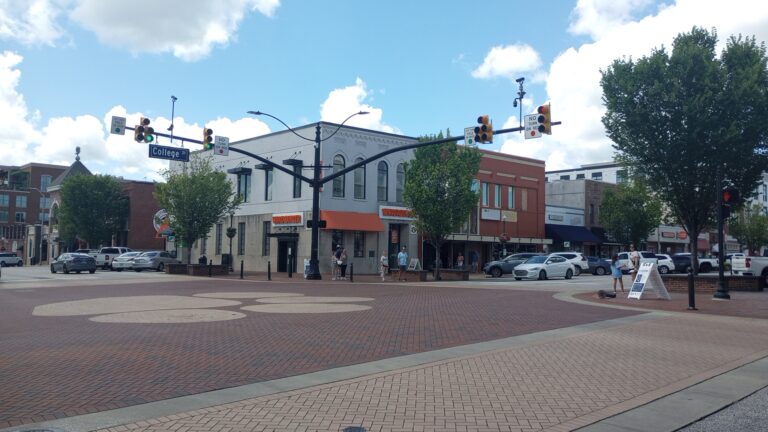
Photo: Wusel007, CC BY-SA 3.0, via Wikimedia Commons.