Boise rent in fall 2026: what apartments actually cost
Boise renters heading into October 2026 face a market where the two most quoted rent trackers disagree by almost $200 a month, HUD’s Fair Market Rents for the Boise area fall for a second straight year on October 1, and a mortgage on the median Ada County house costs about $1,100 a month more than the average three-bedroom apartment. This report pulls the September and August 2026 numbers together with their sources and works out the income each unit size demands at the 30 percent rule.
Three trackers, three Boise rent figures, and why they disagree
Zumper’s Boise page, last updated September 27, 2026, puts the median asking rent across every listing type at $1,595 a month, 6 percent higher than a year earlier. The same page says average rent prices in Boise “increased by 9% over the last month” and that the city sits “16% below the national average rent, or $305 less per month.” RentCafe’s Boise page, updated August 31, 2026, puts the average apartment rent at $1,781 for an average unit of 865 square feet, a 4.99 percent increase from $1,696 a year earlier. The Census Bureau’s American Community Survey for 2019-2023 reports a median gross rent of $1,359 (plus or minus $28) for the City of Boise, a figure that includes utilities and covers every renter household, not just the ones signing leases this month.
The gap comes from method. RentCafe builds its averages from Yardi Matrix data and says the data covers “all Boise apartment buildings with 50 or more units” (RentCafe, August 31, 2026). Zumper states that its “rent prices are based on Zumper’s rental listings from the past 30 days” and that the “median rent is calculated across all available listings and property types on the platform” (Zumper, September 27, 2026), so houses, duplexes and small-landlord units all count. The ACS surveys households rather than listings, so it includes leases signed years ago at older prices, which is why it runs lowest. Read RentCafe as the large-complex price, Zumper as the asking-rent pulse across all property types, HUD’s Fair Market Rent as the voucher benchmark, and the ACS as the baseline the whole city pays.
Studio, one, two and three bedrooms: the fall 2026 price sheet
The table below lines up three sources by bedroom count. HUD’s figures are the FY2027 Fair Market Rents for the Boise City, ID HUD Metro FMR Area, which covers Ada, Boise, Canyon and Owyhee counties and takes effect October 1, 2026 (HUD FY2027 FMR schedule; Federal Register notice, September 1, 2026). The ACS column is the 2019-2023 median gross rent by bedroom count for Boise city (Census table B25031).
| Unit | HUD FMR FY2027 (Boise City HUD Metro FMR Area) | RentCafe average, Aug 31, 2026 | ACS 2019-2023 median gross rent, Boise city |
|---|---|---|---|
| Studio | $1,152 | $1,447 (436 sq ft) | $1,021 |
| 1 bedroom | $1,295 | $1,601 (676 sq ft) | $1,133 |
| 2 bedroom | $1,540 | $1,817 (963 sq ft) | $1,342 |
| 3 bedroom | $2,132 | $2,076 (1,249 sq ft) | $1,749 |
One comparison deserves a note: HUD’s three-bedroom FMR of $2,132 sits slightly above RentCafe’s three-bedroom average of $2,076, which matters for voucher holders and is covered below.
Depot Bench to Morris Hill: neighborhood rents from the August 2026 survey
RentCafe publishes an average for 18 Boise-area neighborhoods, all as of August 31, 2026 and all limited to buildings of 50 units or more:
- Downtown, East End and the Highlands. Downtown Boise averages $1,925, East End Boise $1,576 and the Highlands $1,566. The North End does not appear in RentCafe’s table at all, so for that neighborhood the ACS city median of $1,359 (2019-2023) and Zumper’s all-property median of $1,595 (September 27, 2026) are the only published citywide anchors.
- The Bench neighborhoods. Depot Bench, at $2,090, is the most expensive neighborhood in RentCafe’s Boise table, while Morris Hill ($1,284) and Central Bench ($1,311) are the two cheapest. In between sit Vista ($1,525), Borah ($1,528) and West Bench ($1,578). An $806 spread between Depot Bench and Morris Hill suggests the individual building sets the price more than the neighborhood label does.
- West and northwest Boise. West Cloverdale averages $2,068, Northwest Boise $1,815, Veterans Park $1,800, Brookdale Meadows $1,714, Maple Grove-Franklin $1,649 and West Valley $1,622. Southwest Ada County Alliance comes in at $1,604.
- Southeast Boise and Garden City. Southeast Boise averages $2,028, third highest in the table, and Garden City, a separate city, averages $1,762.
Meridian and Eagle: the suburban comparison depends on who is counting
On RentCafe’s apartment-only measure the suburbs cost about the same as Boise or slightly more: Meridian averages $1,806 and Eagle $1,945 against Boise’s $1,781, with Nampa at $1,603 and Caldwell at $1,665 (RentCafe, August 31, 2026). On Zumper’s all-property median the suburban premium is large: Meridian $2,250, up 6 percent over the year, and Eagle $2,550, up 8 percent, against Boise’s $1,595 (Zumper, September 27, 2026).
The Census baseline points the same direction. ACS 2019-2023 median gross rent is $1,714 in Meridian, $1,753 in Eagle, $1,647 in Kuna and $1,622 in Star, all well above Boise’s $1,359, while Nampa ($1,340) and Garden City ($1,206) run below it (Census table B25064). One plausible explanation is the mix of rentals: a median that includes rented houses will sit above an apartment-only average. Compared like with like, RentCafe’s large-complex average in Meridian is only $25 a month above Boise’s.
HUD’s Fair Market Rents drop again on October 1 for FY2027
The federal benchmark is moving the opposite way from the trackers. HUD’s FY2027 FMRs for the Boise City area, effective October 1, 2026, are $1,152 for an efficiency, $1,295 for one bedroom, $1,540 for two, $2,132 for three and $2,574 for four (HUD FY2027 FMR schedule). The FY2026 figures they replace were $1,170, $1,381, $1,655, $2,318 and $2,772 (HUD FY2026 FMR documentation), so the two-bedroom falls 6.9 percent, the three-bedroom 8.0 percent and the studio 1.5 percent.
The FY2026 numbers were themselves held up by a rule. HUD’s formula for FY2026 started from a $1,234 two-bedroom base rent from the 2019-2023 ACS, multiplied it by a recent-mover factor of 1.1417, a 2024 inflation factor of 1.01781 and a trend factor of 1.05761, and arrived at $1,517 for a two-bedroom. Because FMRs may not fall below 90 percent of the prior year, HUD set every FY2026 bedroom size at exactly 90 percent of FY2025, which is why FY2025’s $1,838 two-bedroom became $1,655 (HUD FY2026 FMR documentation). For FY2027 HUD moved the base to 2020-2024 ACS data and applies the same 90 percent limit (Federal Register, September 1, 2026). The new $1,540 two-bedroom sits above the $1,490 that limit would allow, and above FY2026’s unfloored $1,517, so the FY2027 cut reflects HUD’s survey-based formula, not the floor.
For a voucher holder the comparison that matters is FMR against what landlords ask. On two bedrooms the FY2027 FMR of $1,540 is $277 below RentCafe’s $1,817 average for large complexes (August 31, 2026), so a two-bedroom voucher falls short in large buildings. On three bedrooms the FMR of $2,132 edges past RentCafe’s $2,076. On studios the gap to large complexes is widest: $1,152 against RentCafe’s $1,447 leaves $295 a month uncovered.
Twelve months of movement: up 5 to 6 percent on the trackers, down 7 on the federal schedule
Over the year to late September 2026, Zumper’s overall Boise median rose 6 percent (Zumper, September 27, 2026).
RentCafe’s apartment-only average rose 4.99 percent in the year to August 31, 2026. The figure that fell, HUD’s two-bedroom FMR at minus 6.9 percent between FY2026 and FY2027 (HUD), comes from survey data and forecasts in HUD’s formula rather than from this fall’s listings.
Income needed at the 30 percent rule
The 30 percent rule says rent should take no more than 30 percent of gross income, which works out to annual income of 40 times the monthly rent. The table applies it to the RentCafe and HUD FY2027 figures above, with an hourly equivalent at 2,080 working hours a year.
| Unit and source | Monthly rent | Annual income needed at 30% | Hourly at 2,080 hours |
|---|---|---|---|
| Studio, HUD FMR FY2027 | $1,152 | $46,080 | $22.15 |
| Studio, RentCafe Aug 2026 | $1,447 | $57,880 | $27.83 |
| 1 bedroom, HUD FMR FY2027 | $1,295 | $51,800 | $24.90 |
| 1 bedroom, RentCafe Aug 2026 | $1,601 | $64,040 | $30.79 |
| 2 bedroom, HUD FMR FY2027 | $1,540 | $61,600 | $29.62 |
| 2 bedroom, RentCafe Aug 2026 | $1,817 | $72,680 | $34.94 |
| 3 bedroom, RentCafe Aug 2026 | $2,076 | $83,040 | $39.92 |
| 3 bedroom, HUD FMR FY2027 | $2,132 | $85,280 | $41.00 |
| All listings median, Zumper Sept 2026 | $1,595 | $63,800 | $30.67 |
Boise’s median household income was $81,308 in the ACS 2019-2023 survey, in 2023 dollars (Census table B19013). On that older figure, a household at the median clears the two-bedroom bar in a large complex ($72,680) but falls short of the $83,040 to $85,280 a three-bedroom demands. Renters are a large share of the city: 36,811 of Boise’s 99,616 occupied housing units were renter-occupied in the same survey, or 37 percent (Census table B25003). A single earner needs $27.83 an hour for a studio in a large building, which is why the $1,284 to $1,311 averages in Morris Hill and Central Bench stand out.
What is driving the market: 14,000 domestic movers, 7 percent mortgages and a flat multifamily pipeline
Migration is accelerating again. The Census Bureau’s Vintage 2025 estimates put the Boise City metro area at 864,243 residents on July 1, 2025, up 18,854 in a year. Net domestic migration, people moving in from other parts of the country minus people moving out, was 14,366 in the year to July 1, 2025, up from 10,455 the year before and 8,029 the year before that, though still below the 25,861 recorded in the year to July 1, 2021 (Census Vintage 2025 metro estimates). Ada County alone reached 546,141 residents with 8,528 net domestic arrivals, up from 5,109 a year earlier, and Canyon County added 5,684 (Census Vintage 2025 county estimates).
Mortgage rates keep would-be buyers renting and owners staying put. Freddie Mac’s Primary Mortgage Market Survey for the week ending September 24, 2026 put the 30-year fixed rate at 7.03 percent, up from 6.30 percent a year earlier. Against that, the FHFA’s National Mortgage Database shows the average interest rate on outstanding Idaho mortgages was 4.2 percent in the first quarter of 2026, with 21.3 percent of loans below 3 percent, 33.8 percent between 3 and 4 percent, and only 19.6 percent at 6 percent or higher (FHFA NMDB, 2026 Q1). About 80 percent of outstanding Idaho mortgages carry a rate below 6 percent, so an owner who sells and buys again would usually take on a higher rate. Boise Regional REALTORS data for August 2026 fits that picture: existing-home inventory in Ada County was 991 listings, down 17.3 percent from a year earlier, with 30 days on market (BRR August 2026 Market Report, IMLS data as of September 8, 2026).
Buying costs about $1,100 a month more than an average three-bedroom apartment. The Ada County median single-family sale price was $595,000 in August 2026, up 6.9 percent year over year, on 955 closed sales; existing homes had a median of $579,900 and new construction $629,000, up 13.8 percent (BRR August 2026). Financing $595,000 with 20 percent down ($119,000) at the 7.03 percent PMMS rate (Freddie Mac) means a $476,000 loan and a principal-and-interest payment of about $3,176 a month before taxes, insurance and any HOA dues; with 10 percent down the payment is about $3,573. RentCafe’s three-bedroom average of $2,076 (August 31, 2026) is $1,100 below the 20-percent-down payment. While that gap holds, households that might otherwise buy have a reason to keep renting, which supports demand for larger units.
New supply is tilting toward houses, not apartments. Census building-permit data for the Boise City metro, published through FRED and updated September 24, 2026, show 7,089 housing units authorized in January through August 2026, up 6.5 percent from 6,657 in the same months of 2025 (FRED series BOIS216BPPRIV). Single-unit permits account for all of the gain, at 5,884 against 5,451 (FRED series BOIS216BP1FH). The difference between the two series, units in buildings of two or more, was 1,205 in the first eight months of 2026 against 1,206 in the first eight months of 2025, essentially unchanged. For full years, multi-unit permits rose from 969 in 2024 to 1,563 in 2025. Set against 14,366 net domestic arrivals in the metro in the year to July 2025, roughly 1,560 multi-unit permits a year is a small addition to rental supply.
In short: a large-complex two-bedroom averages $1,817, the FY2027 two-bedroom FMR is $1,540, and a financed median house costs about $1,100 a month more than an average three-bedroom apartment.
How this guide was made. Figures come from the sources named next to each number. A first draft was written with the help of an AI language model; every place name, price, date and claim was then checked against primary sources by the Small City Guide editors (see About and Methodology). Last verified: September 26, 2026.
What changed: First published September 2026; 23 figures corrected in fact-check. On September 27, 2026 every named place and figure was re-checked; details that could not be confirmed from a primary source were removed.
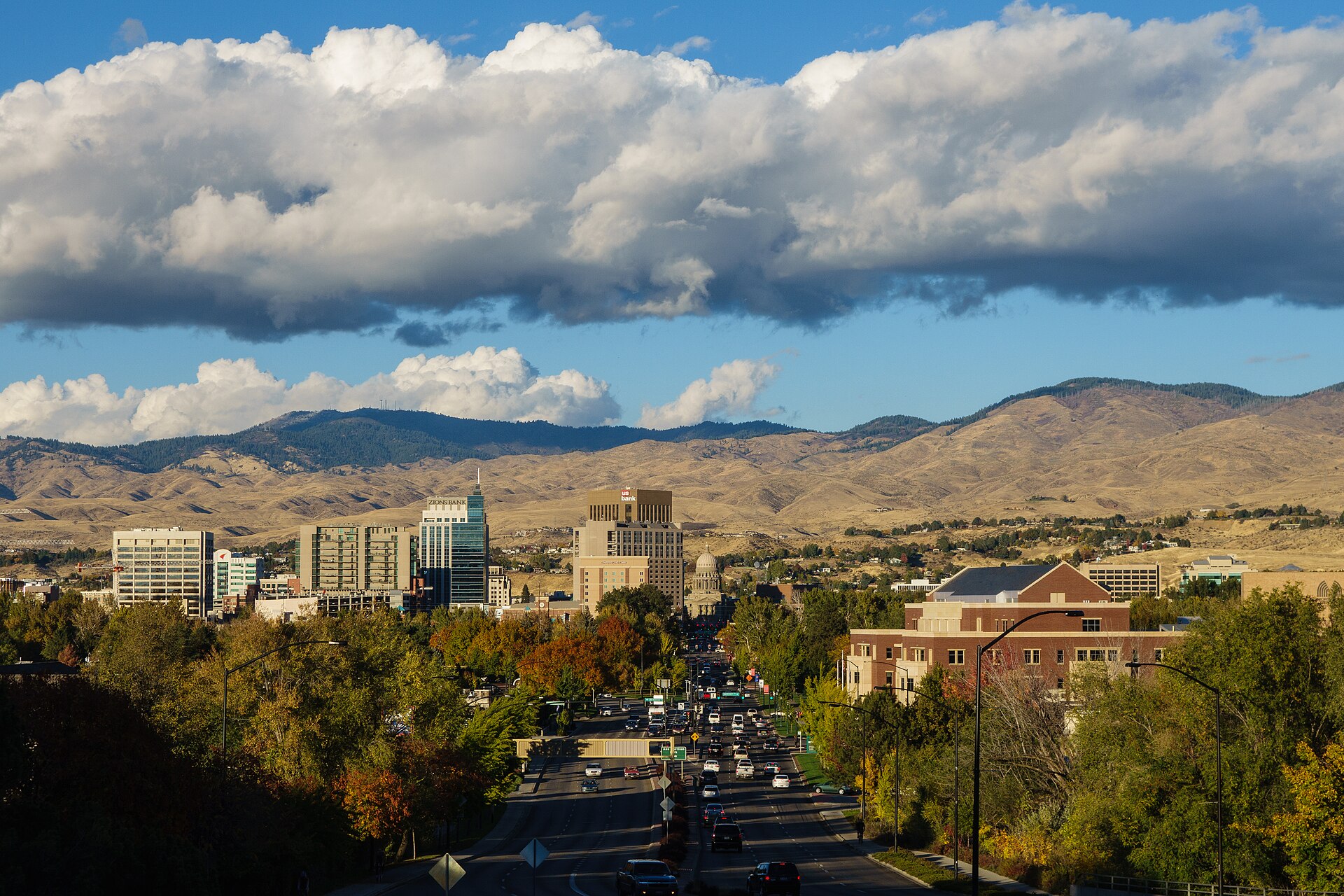
Photo: Robbymilo, CC BY-SA 4.0, via Wikimedia Commons.