Greenville, SC Cost of Living in 2026: Housing and More
Greenville, South Carolina, a city of about 71,800 people on I-85, about 100 miles from Charlotte and 145 miles from Atlanta, has a median home value of $453,300 against a median household income of $68,460, according to Census ACS 2019 to 2023 estimates. Most households rent, and the median gross rent is $1,248 a month. With 30-year mortgage rates near 7% in September 2026 by Freddie Mac’s weekly survey, this guide breaks down what housing, food, transportation and health care cost here.
Here is what it actually costs to live here in 2026, category by category, with the honest tradeoffs included.
Overview: What Kind of City Is Greenville?
Greenville sits in the northwestern corner of South Carolina, about 100 miles from Charlotte and 145 miles from Atlanta. It is not a suburb of either. It has its own economy, its own identity, and its own set of problems.
The U.S. Census Bureau’s 2019 to 2023 American Community Survey puts the city’s population at 71,755, with a median age of 34.8 years. That median age tells you something important: this is a city drawing younger professionals, not retirees. Michelin, Prisma Health and Bon Secours are among Greenville County’s largest employers, and BMW builds cars at its plant between Greenville and Spartanburg. The unemployment rate sits at 4%, below the 5.2% national rate in the same Census survey.
The median household income is $68,460 per year, and 55% of residents hold a bachelor’s degree or higher. That education rate is notably high for a city of this size and reflects both the professional workforce and the proximity to Furman University and Clemson University’s automotive research campus, CU-ICAR. The flip side: a poverty rate of 14.1% means a meaningful portion of the population is not sharing in that prosperity.
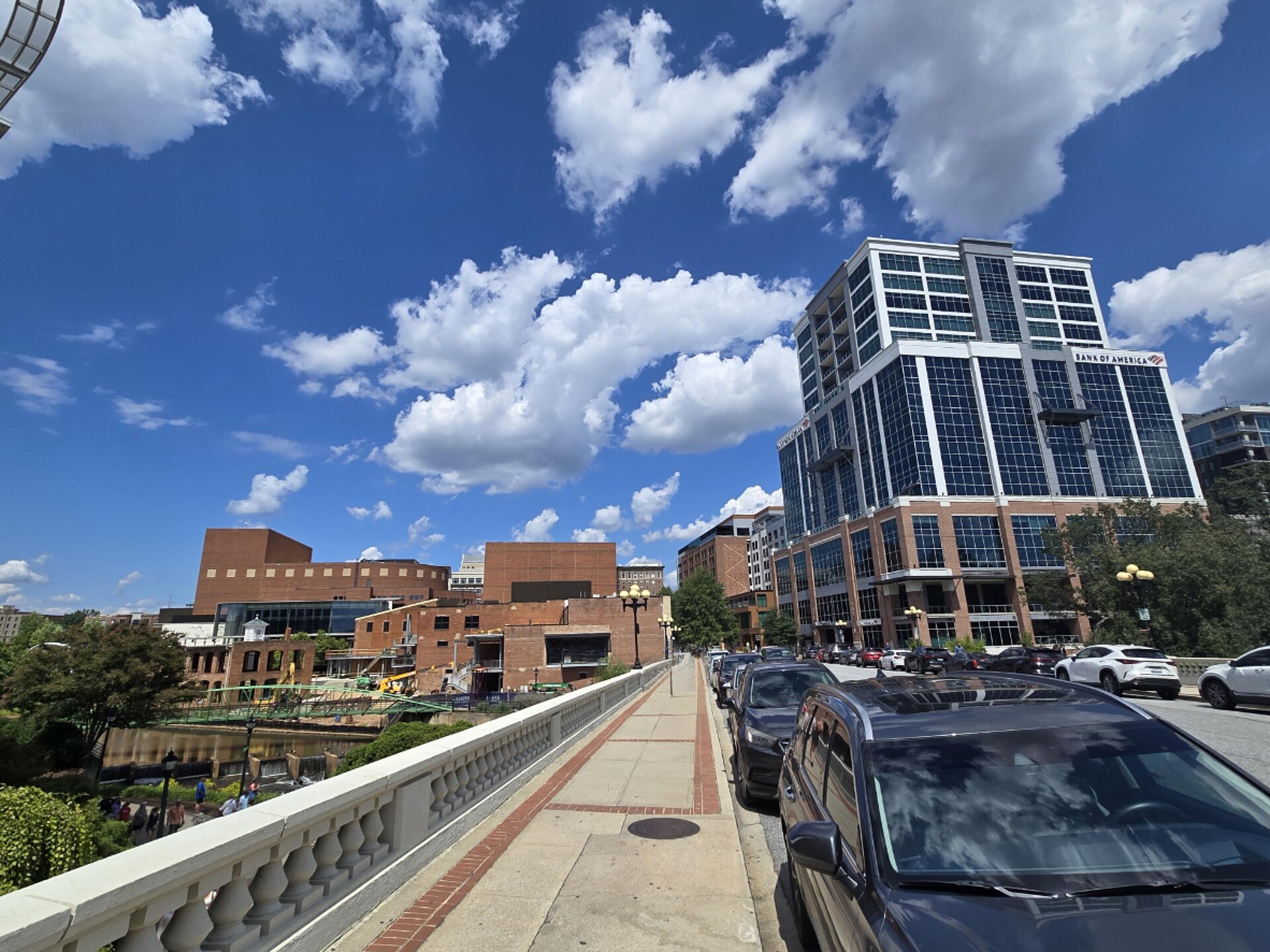
Downtown Greenville is genuinely walkable by Southern city standards. Falls Park on the Reedy is legitimately beautiful, Main Street has real restaurants and foot traffic, and the West End has developed into a lively mixed-use district. But outside the downtown core, you are in car-dependent suburbia. Plan accordingly.
Housing Costs: Rent and Buying in 2026
The Census ACS data pegs the median gross rent at $1,248 per month and the median home value at $453,300. The homeownership rate is just 41.2%, which is low. For context, the national homeownership rate hovers around 65%. That gap reflects two things: a lot of young renters and a housing market that moved faster than incomes. Renting is not a temporary phase for most Greenville residents; it is a long-term reality for nearly six in ten households.
That Census median covers all unit sizes and building ages across the city.
Buying a Home in Greenville in 2026
That $453,300 median home value is the number that trips people up. By the same Census survey, that is higher than the median home values for Charlotte ($351,500) and Atlanta ($420,600).
At current mortgage rates (Freddie Mac’s weekly average for a 30-year fixed was 7.03% on September 24, 2026, up from about 6.0 to 6.2% in early 2026), a $400,000 home with 10% down means about $2,400 a month in principal and interest alone at 7.03%, before property taxes and insurance. That is a significant chunk of a $68,460 household income. The math works better with two incomes or a larger down payment.
Food and Groceries
South Carolina does not charge its state sales tax on unprepared food, which helps. Publix is among Greenville County’s largest employers, and Trader Joe’s (59 Woodruff Industrial Lane) and Whole Foods (1140 Woodruff Road) both have Greenville stores.
Dining out is where Greenville genuinely earns its reputation. The food scene on and around Main Street is above what you would expect for a city of 70,000. Soby’s, at 207 South Main Street, and Jianna, at 600 South Main Street overlooking Falls Park, are two of the downtown restaurants on that stretch.
Transportation: You Need a Car
Greenville has public transit, but it is thin. Greenlink runs buses across much of Greenville County, including Mauldin and Simpsonville, plus a downtown trolley, but its routes and frequency are limited enough that it is not a realistic daily commute option for most residents. If you move here without a car, your geography shrinks dramatically. Even downtown residents who can walk to work will need a car for groceries, medical appointments, and weekend activities.
Downtown has more than 8,000 parking spaces, including 800 free on-street spaces, and the City runs 18 parking facilities. The first hour is free in any City garage, day or night, and free parking is available in select locations on weekends and evenings. The City also sells monthly garage permits, including a $36-a-month Night Owl permit for evenings and weekends.
Healthcare: Hospitals and Clinics
Greenville’s healthcare infrastructure is strong relative to its size. Prisma Health Greenville Memorial Hospital is the Upstate’s main referral hospital and has a 24-hour Level I Trauma Center. Bon Secours St. Francis is the other main health system, with St. Francis Downtown and St. Francis Eastside among its sites. Both systems are large employers and providers of reasonably comprehensive care.
For uninsured residents, the Greenville Free Medical Clinic on Arlington Avenue provides medical and dental care and prescription medications without charge to eligible low-income, uninsured Greenville County residents. Given the city’s 14.1% poverty rate, that kind of safety-net care matters.
Entertainment and Lifestyle
Greenville punches above its weight on lifestyle. That is a genuine observation, not a Chamber of Commerce talking point.
The Greenville Swamp Rabbits (ECHL hockey) play at Bon Secours Wellness Arena. The Greenville Drive, the High-A affiliate of the Boston Red Sox, play at Fluor Field at the West End, a ballpark designed to echo features of Fenway Park. The Peace Center hosts Broadway shows, classical music and pop acts, and is home to the Greenville Symphony Orchestra.
Outdoor recreation is the strongest lifestyle argument for Greenville. The Swamp Rabbit Trail, a multi-use rail trail connecting downtown Greenville to Travelers Rest, is excellent. Paris Mountain State Park is about five miles north of the city. Greenville sits in the foothills of the Blue Ridge Mountains, and Sassafras Mountain, the highest point in South Carolina, is less than 40 miles northwest.
Greenville vs. Charlotte and Atlanta
People often compare Greenville to its larger neighbors when considering a move. Here is the honest comparison:
Greenville vs. Charlotte, NC
By the same 2019 to 2023 Census survey, Charlotte’s median home value is $351,500, below Greenville’s $453,300, while its median gross rent is $1,504 against Greenville’s $1,248. Charlotte’s median household income is higher, at $78,438. Charlotte is the second-largest banking center in the country and has a light rail line, the Lynx Blue Line. Greenville is the cheaper place to rent, but not to buy.
Greenville vs. Atlanta, GA
Atlanta is a different league. By the same Census survey, Atlanta’s median home value is $420,600 and its median gross rent is $1,617, with a median household income of $81,938. Atlanta has Hartsfield-Jackson, the world’s busiest airport by passenger traffic, four major league teams, and significant cultural infrastructure. For people who need that scale, Greenville does not compete. For people who want a city-ish lifestyle at lower rents, Greenville is a legitimate alternative.
The Honest Pros and Cons
Pros
- Genuinely walkable downtown by Southern city standards, with real restaurants and culture.
- Outdoor access is excellent, with mountains, trails, and lakes all within range.
- Lower rents than Charlotte or Atlanta: the Census median gross rent is $1,248 here, against $1,504 in Charlotte and $1,617 in Atlanta.
- Strong healthcare infrastructure relative to the population size.
- 4% unemployment and a diversified employer base across manufacturing, healthcare, and professional services.
- No state income tax on Social Security benefits.
Cons
- Car-dependent everywhere outside downtown. Greenlink buses exist, but routes and frequency are limited.
- Housing has gotten expensive relative to local incomes. A $453,300 median home value against a $68,460 median income is not an easy ratio.
- 14.1% poverty rate reveals economic stratification that the shiny Main Street corridor obscures.
- Limited job market depth compared to Charlotte or Atlanta, especially in finance, where Charlotte is the second-largest banking center in the country.
- Hot and humid summers. The city averages 43 days a year at or above 90°F.
Who Is Greenville Right For?
The Remote Worker with a Non-Local Salary
If you are earning $90,000 or more from a remote job tied to a higher cost-of-living market, Greenville can be a strong value, especially for renters: the Census median gross rent here is $1,248, against $1,504 in Charlotte and $1,617 in Atlanta. Buyers get less of an edge, since Greenville’s median home value is higher than either city’s.
The Manufacturing or Healthcare Professional
BMW, Michelin, GE Vernova (the former GE Power), and the Prisma and Bon Secours hospital systems employ thousands in and around Greenville. If your career is in engineering, supply chain, nursing, or allied health, these employers are the core of the local job market.
The Young Professional Willing to Rent and Build
With a median age of 34.8 and 55% of residents holding a bachelor’s degree or higher, Greenville has genuine social infrastructure for young professionals. The dating pool, social scene, and professional networking are solid for a city this size. Renting downtown for a few years while building savings is a viable strategy, though buying downtown on a single income will be a stretch.
The Outdoor-Focused Family or Couple
If weekends mean hiking, mountain biking, kayaking, or trout fishing rather than brunch and museums, Greenville’s location is genuinely hard to beat. The Blue Ridge Escarpment, Table Rock State Park, and the Chattooga River are all accessible.
The Bottom Line
Greenville is not a bargain for buyers: its median home value is above Charlotte’s and Atlanta’s. But rents are lower than in either city, it has a functional and pleasant downtown, and the quality of daily life for someone earning around or above the $68,460 median is genuinely good.
The risks are real too. Buying a home here at current prices requires either a solid dual income or significant equity from a previous sale. The car dependency is non-negotiable. And the income inequality embedded in that 14.1% poverty rate is a policy challenge the city has not solved.
For the right profile, though, this is one of the better mid-sized cities in the South to plant a flag in 2026. Just go in with accurate numbers, not brochure copy.
Frequently Asked Questions
What is the average rent in Greenville, SC in 2026?
Is Greenville, SC a good place to buy a house in 2026?
How does the cost of living in Greenville, SC compare to Charlotte, NC?
Do you need a car to live in Greenville, SC?
What is the average household income in Greenville, SC?
Sources & methodology. Demographic and economic figures in this guide are drawn from the U.S. Census Bureau, 2019 to 2023 American Community Survey 5-Year Estimates. A newer 2020 to 2024 release came out on January 29, 2026; this guide still uses the 2019 to 2023 figures. Other figures come from the sources named next to them.
Last reviewed September 2026.
How this guide was made. Figures come from the U.S. Census Bureau ACS 2019 to 2023 5-year estimates and the other sources named next to each number. A first draft was written with the help of an AI language model; every place name, price, date and claim was then checked against primary sources by the Small City Guide editors (see About and Methodology). Last verified: September 26, 2026.
What changed: Fact-checked against primary sources in September 2026: 7 statements corrected, opening rewritten, photo replaced with a credited image of the city.
Photo: Spatms, CC BY-SA 4.0, via Wikimedia Commons.