Sedona, AZ Cost of Living in 2026: Housing and Transit
Sedona is a resort town of about 9,770 people split between Yavapai and Coconino counties, and its housing costs run far ahead of local pay: the Census Bureau puts the median home value at $708,400 against a median household income of $67,374. Groceries come from a few supermarkets in West Sedona, transit is a city trailhead shuttle plus an hourly bus to Cottonwood, and hospital beds are in Cottonwood and Flagstaff. This guide covers what housing, food, transportation and healthcare cost residents in 2026.
Overview: What Kind of Place Is Sedona?
Sedona straddles Yavapai and Coconino counties in north-central Arizona, about 28 miles south of Flagstaff and about 119 miles from Phoenix Sky Harbor International Airport. It’s divided loosely into Uptown (the tourist commercial strip), West Sedona (where most actual residents live and shop), the Village of Oak Creek to the south, and a handful of quieter canyon communities like Oak Creek Canyon to the north.
The median household income here is $67,374 per year, which sounds reasonable until you stack it against a median home value of $708,400. That ratio is brutal. A household earning the local median would need to spend roughly 10.5 times their annual income to buy a median-priced home. The high homeownership rate of 73.3% reflects not a city where locals are building equity easily, but one where retirees and remote workers with outside wealth have already paid off or largely paid down property purchased years ago.
The unemployment rate of 7.1% is notably high for Arizona, a signal that the local economy is heavily tourism-dependent and seasonal. The poverty rate of 13.7% tells the same story: a significant share of Sedona residents work in hospitality, retail, and service jobs that don’t pay enough to live here comfortably. Half the adult population holds a bachelor’s degree or higher (51%), reflecting the strong retiree and remote-professional demographic.
The vibe is simultaneously spiritual and commercial. You’ll find crystal shops next to Whole Foods, yoga retreats next to jeep tour operators, and trail runners sharing the road with tour buses. It’s genuinely beautiful. It’s also genuinely crowded with day-trippers from Phoenix, and that tension shapes everyday life for residents.
Housing Costs: Renting and Buying in 2026
The Census Bureau’s 5-year estimates peg the median gross rent at $1,421 per month, but that figure masks a wide range depending on where you look and what you’re willing to accept.
Renting by Neighborhood
West Sedona is the most practical neighborhood for renters, with the closest thing to a normal grocery-and-errand corridor on State Route 89A, where the Whole Foods Market and Safeway sit.
Village of Oak Creek is an unincorporated community about 7 miles south of Sedona, outside the city limits, that works largely as a bedroom community for Sedona. The tradeoff is more distance from Sedona’s core.
Short-term rentals compete for the same homes. The City of Sedona says more than 16% of the city’s housing inventory has been converted into short-term rentals, which directly shrinks the pool of homes available to permanent residents.
One hard truth: inventory is thin. Sedona is a small town with 9,770 people and a 73.3% homeownership rate, which means fewer than 30% of households are renters to begin with. When a unit comes available, competition is real.
Buying in 2026
The median home value of $708,400 is a midpoint, not a ceiling: half of owner-occupied homes are valued above it.
At a 7% fixed rate on a $650,000 purchase with 20% down, you’re looking at roughly $3,460 per month in principal and interest alone, before property taxes and HOA fees. Property taxes offer some relief: the Census Bureau puts the median annual real estate tax bill for Sedona homeowners at $3,219. Still, a buyer at the median price point needs a household income significantly above Sedona’s $67,374 median to qualify comfortably. Most buyers here are bringing equity from a previous home sale or retirement savings, not qualifying on local income alone.
Food and Groceries
Sedona has a Whole Foods Market (1420 W. State Route 89A) and a Safeway (2300 W. Hwy 89A), both in West Sedona, plus a Bashas’ grocery store. That is essentially it for major grocery options in town. For more choice, residents drive to Flagstaff (28 miles north) or Cottonwood (about 20 miles southwest), with Prescott more than twice as far.
Transportation
Sedona has some public transit, but not enough to live without a car. The city-run Sedona Shuttle, launched in March 2022, runs free routes from park-and-ride lots to the Dry Creek Vista/Mescal, Soldier Pass and Cathedral Rock/Little Horse trailheads Thursday through Sunday. Sedona Shuttle Connect is an app-based on-demand service within town for $2 per rider ($1 for seniors). The Verde Shuttle runs hourly between Sedona and Cottonwood seven days a week from 6 a.m. to 10 p.m., at $2 one way, $1 for trips within Sedona or $60 for a monthly pass. Most residents still own a car. You need a car. Full stop.
The Red Rock Pass ($5 per day, $15 per week or $20 per year) is required for parking at many Sedona-area National Forest trailhead lots; an America the Beautiful interagency pass also works.
Healthcare
Sedona does not have a full-service hospital within city limits. The main medical option in town is Northern Arizona Healthcare’s Verde Valley Medical Center Sedona campus, which has a free-standing emergency department staffed 24/7 along with primary care and outpatient services. For anything requiring inpatient hospital care, trauma services, or major surgery, residents travel to Verde Valley Medical Center’s main campus in Cottonwood (about 20 miles southwest) or to Flagstaff Medical Center (28 miles north). Flagstaff Medical Center is the region’s Level I trauma center and handles the most complex cases.
The older-than-average population (median age 59) means healthcare is a significant budget line for many Sedona residents. With 38.6% of residents aged 65 or older, according to the Census Bureau, Medicare covers a substantial share of the community. The 13.7% poverty rate also suggests a meaningful portion of the population is navigating these costs with limited financial cushion.
Entertainment and Lifestyle
This is where Sedona actually delivers outsized value, as long as your idea of entertainment involves the outdoors. The trail network is exceptional. Bell Rock, Cathedral Rock, Devil’s Bridge, Vultee Arch, and dozens of lesser-known routes are close to town. An annual Red Rock Pass ($20) covers parking at Sedona-area Forest Service fee sites, though not the concessionaire-run day-use areas such as Crescent Moon or Grasshopper Point. Hikers, mountain bikers, and trail runners have access to a world-class landscape for almost nothing.
Beyond the outdoors, Sedona has a small but serious arts community concentrated around Tlaquepaque Arts and Shopping Village and the Sedona Arts Center. There are independent galleries, live music venues, and a handful of genuinely good restaurants. The Sedona International Film Festival in late February draws a real crowd and is legitimately well-regarded in the regional film community.
What Sedona lacks is everyday entertainment variety. The Sedona International Film Festival shows new films, Met Opera broadcasts and live theater broadcasts year-round at its Mary D. Fisher and Alice Gill-Sheldon theatres, but there are no major league or minor league sports teams and no large music venues. If you need a city’s cultural infrastructure, you’ll feel the absence. The median age of 59 reflects a community that has largely self-selected around a quieter lifestyle. Young families and twenty-somethings often find Sedona isolating after the initial novelty of the landscape wears off.
How Sedona Compares to Flagstaff and Phoenix
Flagstaff, AZ sits 28 miles north and offers a dramatically different cost structure. The Census Bureau puts Flagstaff’s median home value at $503,400 (2019 to 2023 estimates), meaningfully lower than Sedona’s $708,400. Flagstaff has Northern Arizona University, a real downtown, and more extensive public transit than Sedona’s trailhead shuttle, on-demand service and hourly bus to Cottonwood. It’s still expensive by Arizona standards, but entertainment options are wider, and the job market (supported by the university, healthcare, and government sectors) is more diverse. The winters are colder and snowier, which is either a feature or a bug depending on your preferences.
Phoenix, AZ is a different universe at scale. The Census Bureau puts the Phoenix metro’s median home value at $401,400 (2019 to 2023 estimates), a little more than half of Sedona’s. Healthcare infrastructure is far more accessible, job options are broad, and public transit (light rail, buses) exists, though car ownership remains dominant. Phoenix summers, with highs above 110 degrees Fahrenheit on about 21 days in an average year, are genuinely harsh in a way that Sedona’s higher-elevation climate (average high of roughly 97 degrees in July) is not. If you’re choosing purely on affordability, Phoenix wins easily. If you’re choosing on quality of natural environment and a quieter pace, Sedona wins and you pay accordingly.
Honest Pros and Cons
The Real Pros
- The landscape is genuinely extraordinary. Living among red rock formations, with immediate access to world-class trails, is not something most American small cities can offer at any price.
- Dry air and high elevation. At roughly 4,360 feet, Sedona avoids the worst of Arizona’s desert heat.
- Strong arts and wellness community. For those who value that culture, it’s unusually concentrated for a town of under 10,000.
- Relatively low property taxes. A median annual real estate tax bill of $3,219 (Census Bureau) partially offsets the high purchase price for homeowners.
The Real Cons
- Housing costs are severe relative to local income. The $708,400 median home value against a $67,374 median household income works out to a home value of about 10.5 times income. Most buyers need outside wealth.
- Tourism congestion is a genuine quality-of-life issue. Sedona draws large crowds of visitors to a town of under 10,000 residents. Traffic, noise, and crowded trails are constant.
- Thin job market. A 7.1% unemployment rate reflects a local economy that simply does not have many professional or trades jobs to offer. Remote workers and retirees are largely insulated from this; everyone else is not.
- Grocery and retail isolation. Only a few supermarkets and limited specialty retail mean frequent drives to Flagstaff or Cottonwood for normal errands.
- Healthcare access requires travel. No hospital within city limits is a real concern for older residents and families with young children.
- Limited social infrastructure for younger residents. The median age of 59 isn’t just a number; it reflects a community culture that can feel isolating for people under 40.
Who Actually Thrives in Sedona
The financially secure retiree. This is the profile Sedona was built for. If you’re entering retirement with a paid-off home to sell, a solid investment portfolio, and Medicare coverage, the equation works. The landscape, the mild (relative to Phoenix) summers, and the wellness-oriented community are genuine quality-of-life wins. The 73.3% homeownership rate and median age of 59 confirm this is already the dominant demographic.
The remote professional with a high income. If you’re earning $120,000 or more per year remotely, Sedona becomes viable even as a renter or a buyer with a mortgage. You can afford the car costs, and the entertainment limitations because you’re buying the landscape and the lifestyle. The 51% bachelor’s degree or higher rate signals that this profile is well-represented in the community already.
The outdoor-focused couple or individual. If hiking, mountain biking, climbing, or trail running is your primary source of recreation and social connection, Sedona offers a level of access and quality that is extremely difficult to match anywhere in the lower 48. For this person, the trade of shopping and entertainment choice for daily access to Cathedral Rock is an obvious win.
The entrepreneur targeting the tourism market. Sedona’s visitor economy is massive relative to its population. Yoga instructors, massage therapists, tour operators, gallery owners, Airbnb hosts (where locally permitted), and food and beverage entrepreneurs can find real opportunity. The 13.7% poverty rate is a reminder that this path is not easy and not guaranteed, but for the right business idea executed well, the customer base walks right through the door.
The Bottom Line
Sedona is not a city where you move to stretch a paycheck. The numbers don’t support that story: a median home value of $708,400, a handful of supermarkets, limited public transit, and a job market posting 7.1% unemployment are all pointing in the same direction. This is a place where the lifestyle is the product, and the lifestyle costs real money.
What you get in return is legitimate. The natural environment is world-class. The community is educated and wellness-oriented. If you arrive with financial security already in place, whether through retirement savings, remote income, or home equity from a previous market, Sedona can deliver on its promise. If you’re hoping the local economy will provide the income to support life here, the data suggests you’ll struggle. Know which category you’re in before you start looking at listings.
Frequently Asked Questions
What is the average rent in Sedona, AZ in 2026?
Is Sedona, AZ expensive to live in compared to Phoenix?
What is the median household income in Sedona, AZ?
Does Sedona, AZ have a hospital?
Is Sedona, AZ a good place to retire?
Sources & methodology. Demographic and economic figures in this guide are drawn from the U.S. Census Bureau, 2019 to 2023 American Community Survey 5-Year Estimates. A newer 2020 to 2024 release came out on January 29, 2026; this guide still uses the 2019 to 2023 figures. Other figures come from the sources named next to them.
Last reviewed September 2026.
How this guide was made. Figures come from the U.S. Census Bureau ACS 2019 to 2023 5-year estimates and the other sources named next to each number. A first draft was written with the help of an AI language model; every place name, price, date and claim was then checked against primary sources by the Small City Guide editors (see About and Methodology). Last verified: September 26, 2026.
What changed: Fact-checked against primary sources in September 2026: 12 statements corrected, opening rewritten, photo replaced with a credited image of the city.
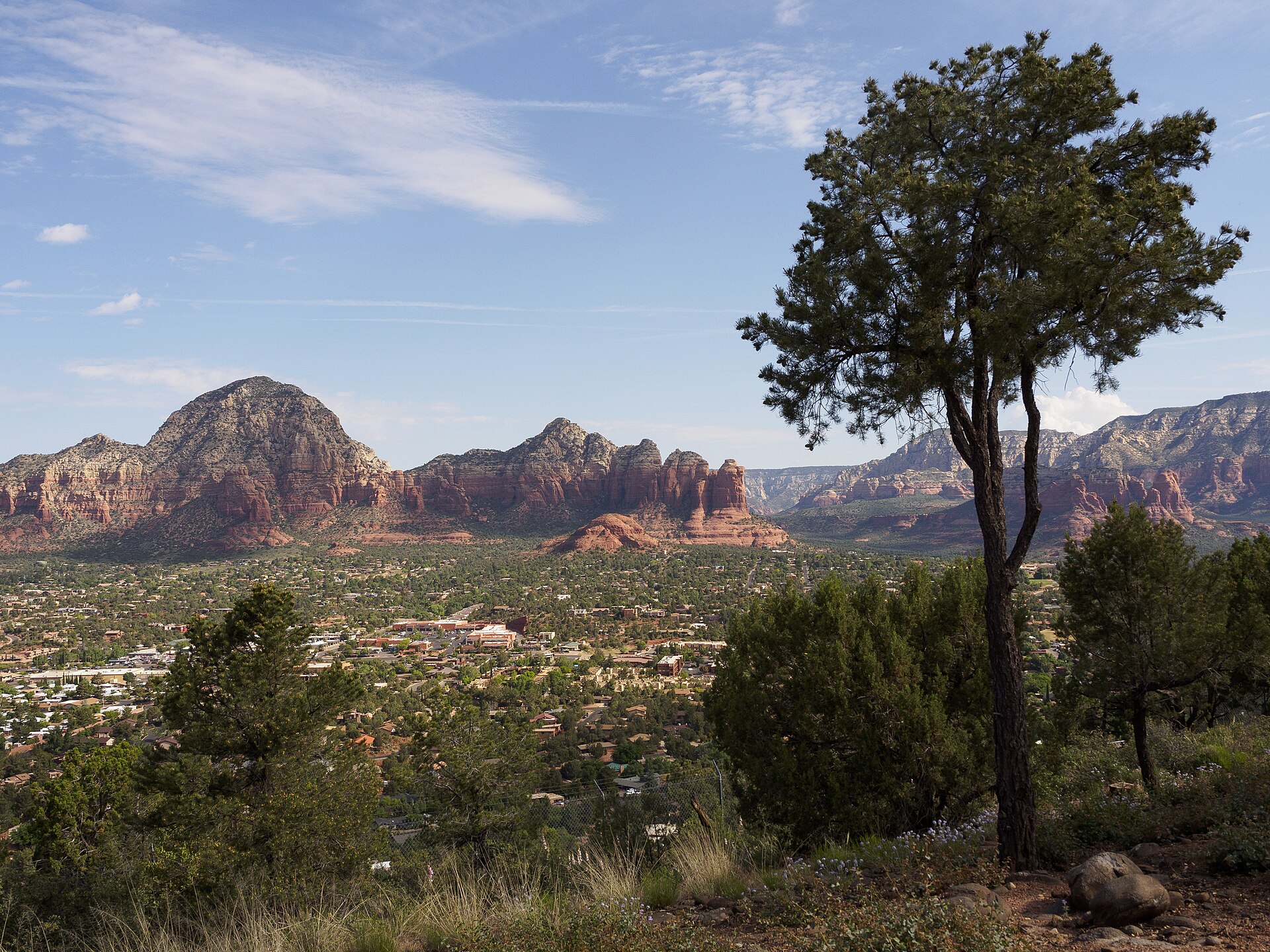
Photo: Nicholas Hartmann, CC BY-SA 4.0, via Wikimedia Commons.