Gilbert, AZ Cost of Living in 2026: Housing and Mortgages
Gilbert, in the southeast Phoenix metro, is the most populous incorporated town in the United States, with 271,118 residents in the Census Bureau’s 2019 to 2023 estimates. The same survey puts the median home value at $518,600, median gross rent at $2,028 a month and median household income at $121,351. This guide walks through housing, groceries, driving, healthcare and utility costs for a household moving to Gilbert in 2026.
Gilbert at a Glance: Population, Vibe, and Location
Gilbert sits in the southeast corner of the Phoenix metro, sharing borders with Chandler to the west and Mesa to the north. It started as a farming town, incorporated in 1920, and stayed small until a growth boom that began in the 1980s and 1990s (29,188 residents in 1990, 109,697 in 2000), which means the infrastructure is almost entirely modern. The roads are wide, the strip malls are new, and nearly everything was built after 1990. That is not a knock; it means functional parking lots, newer school buildings, and housing stock that does not require a gut renovation.
The median age of 35.7 years tells you something important: this is a city built around young families. You will notice it everywhere, from the packed youth soccer fields on Saturday mornings to the density of pediatric dental offices in every commercial corridor. The poverty rate sits at just 5.1%, and the unemployment rate is 3.3%. The median household income of $121,351 reflects a highly educated workforce; 47.5% of residents hold a bachelor’s degree or higher, which is well above both state and national averages.
The Heritage District, a small cluster of walkable restaurants and bars in the old town core, gets cited endlessly in lifestyle pieces. It is genuinely good. But one walkable neighborhood does not make a walkable city, and Gilbert is, in almost every other respect, a car-dependent suburb. Manage that expectation going in and you will not be disappointed.
Housing Costs: What You Will Actually Pay in 2026
The Census Bureau’s 2019 to 2023 American Community Survey puts Gilbert’s median home value at $518,600 and the median gross rent at $2,028 per month. Those figures reflect a market snapshot from that period. Several of Gilbert’s neighborhoods are master-planned communities.
Buying a Home
The homeownership rate in Gilbert is 73.9%. Most people here buy. That rate reflects a cultural expectation as much as an economic one; the city attracts households who are planting roots, not passing through.
Neighborhoods buyers often hear about:
- Cooley Station and Power Ranch: Cooley Station is a master-planned community on Williams Field Road between Higley and Power Roads, with parks, open space and walking and biking trails. Power Ranch is managed by the Power Ranch Community Association.
- Agritopia and Morrison Ranch: Agritopia is a 166-acre planned community built around urban farmland, and Morrison Ranch is a master-planned community in the heart of Gilbert.
At a 30-year fixed rate of about 6% to 6.2% in early 2026 (Freddie Mac’s weekly average, which rose to 7.03% by September 24, 2026), a $550,000 purchase with 10% down produces a monthly principal and interest payment of roughly $3,000, or about $3,300 at the September rate. Property taxes, homeowner’s insurance and any HOA fees come on top of that.
Renting
The Census median gross rent of $2,028 per month is a median across all rental units, so individual units rent above or below it depending on size, age and location.
Renters should note that with a 73.9% homeownership rate, most of Gilbert’s housing is owner-occupied.
Food and Groceries: The Monthly Reality
Gilbert is well-served for grocery shopping. Options include Fry’s, two Sprouts Farmers Market stores (on Higley Road and on Val Vista Drive), and an AJ’s Fine Foods just north of town at Val Vista Drive and Baseline Road in Mesa for premium shopping.
Dining out is where Gilbert genuinely punches above its weight for a suburb. The Heritage District has developed into a legitimate restaurant corridor. Postino East, Joe’s Real BBQ, and Liberty Market have loyal followings.
One honest note: if you are used to the dining variety of a dense urban core, Gilbert’s restaurant scene, while improving, still skews toward family-friendly American and chain concepts outside of the Heritage District. That is the tradeoff for the lower crime rates and newer infrastructure.
Transportation: Plan to Drive
There is no version of life in Gilbert that does not center on a car. The Valley Metro light rail does not reach Gilbert, and while bus service exists, it is infrequent and impractical for daily commuting to most destinations. If you are relocating from a city where you walked or took transit to work, this is the most significant lifestyle adjustment you will make.
Parking is almost universally free throughout Gilbert. This is one genuine advantage over denser metro areas. Parking has never been a line item in a Gilbert budget, and that is not likely to change.
If you work in Tempe or downtown Phoenix, budget extra commute time. Gilbert is served mainly by the Santan Freeway portion of Loop 202, and a short section of US 60 runs along its northern edge at the Higley Road interchange.
Healthcare: Facilities and Costs
Gilbert has solid healthcare infrastructure for a city that only recently crossed the 250,000 population threshold. Dignity Health Mercy Gilbert Medical Center (Dignity Health is part of CommonSpirit Health) offers emergency care and a range of specialty services. Banner Health operates Banner Gateway Medical Center nearby in Gilbert as well, giving residents two full-service hospital options within a short drive.
For routine care, the Phoenix metro has a dense network of urgent care centers and primary care providers.
Entertainment and Lifestyle
Gilbert’s entertainment spending is suburban by nature. The SanTan Village outdoor mall is the commercial hub for most residents: movies, chain restaurants, clothing retail, and a busy weekend scene.
Outdoor recreation is a legitimate lifestyle anchor here. San Tan Mountain Regional Park, south of neighboring Queen Creek in Pinal County, offers miles of hiking and mountain biking trails with a vehicle entry fee of $10 (Maricopa County raised park fees on January 1, 2026, with another increase scheduled for 2028). The weather makes outdoor activity genuinely pleasant from October through April. June through August, with temperatures regularly exceeding 110 degrees Fahrenheit, is another story.
How Gilbert Compares to Scottsdale and Tempe
Scottsdale is the most direct comparison most people make. It is a genuine upgrade in dining, nightlife, and luxury amenities, but you pay for it. The Census Bureau’s 2019 to 2023 survey puts Scottsdale’s median home value at $709,900, against $518,600 in Gilbert, although Scottsdale’s median gross rent ($1,910) is slightly lower than Gilbert’s. If your lifestyle priorities run toward world-class restaurants, resort pools, and boutique retail, Scottsdale delivers things Gilbert cannot match, but buyers will spend significantly more to access them.
Tempe offers a different trade. It is denser, more walkable near Arizona State University, and has light rail access. Census figures for 2019 to 2023 put Tempe’s median gross rent at $1,623 and its median home value at $421,900, both below Gilbert’s. The tradeoff is older housing inventory, denser traffic, and a more transient demographic. Tempe makes more sense for someone who wants urban amenities and does not need a large house; Gilbert makes more sense for a family that wants space, newer schools, and quieter streets.
The Honest Pros and Cons
What Works in Gilbert’s Favor
- Schools: Most of Gilbert is zoned to Gilbert Public Schools (Gilbert Unified School District), with other parts served by Higley Unified, Chandler Unified and Mesa Public Schools.
- Safety: Gilbert has been listed among the 25 safest cities in the United States.
- New infrastructure: Roads, utilities, and public facilities are modern and well-maintained. This is not a city with deferred maintenance problems.
- Income and job stability: A median household income of $121,351 reflects a community with real financial resilience. Layoffs in one sector do not crater the local economy.
- Healthcare access: Two hospitals with emergency departments, Mercy Gilbert Medical Center and Banner Gateway Medical Center, are inside town limits.
Real Downsides You Should Know
- Heat: Summer in Gilbert is brutal. Three-plus months of extreme heat limits outdoor life in ways that affect quality of life for people who value being outside. Higher summer electricity bills are part of the bargain.
- Car dependency: No light rail, limited transit, and a layout designed entirely around the automobile. If you are a non-driver or dislike driving, this is the wrong city.
- Cultural homogeneity: The demographics skew heavily toward a particular slice of suburban America. The restaurant and cultural scene reflects that. International food variety and arts programming are limited compared to Tempe or Phoenix proper.
- Housing costs relative to the rest of the country: At a median home value of $518,600, Gilbert is not cheap. Buyers from the Midwest or South often experience sticker shock.
- HOA culture: In most of Gilbert’s master-planned communities, HOAs are not optional. If you object to rules about fence colors, trash can placement, or landscaping standards, this will be a friction point.
Who Is Gilbert Actually Right For?
Young Families with School-Age Children
This is Gilbert’s core constituency, and for good reason. The school quality, safety, park infrastructure, and family-oriented commercial landscape all reinforce each other. The environment delivers what families actually want.
Remote Workers Relocating from High-Cost Markets
Someone leaving San Jose, Seattle, or Denver with a remote salary calibrated to those markets will find Gilbert dramatically more affordable on a relative basis.
Healthcare and Tech Professionals Working in the East Valley
The Chandler and Gilbert healthcare and semiconductor corridors, anchored by employers like Intel (in Chandler) and Banner Health, one of Gilbert’s largest employers, generate exactly the kind of professional workforce that Gilbert has built itself around. Short commutes to major East Valley employers are one of Gilbert’s practical advantages over living in Phoenix proper.
Retirees Seeking Modern Amenities Without Urban Density
The quiet streets, accessible healthcare, low crime, and warm winters also draw retirees, even if the median age of 35.7 skews younger. Active retirees who want walkable parks, quality medical care, and proximity to Scottsdale’s leisure amenities find Gilbert a more affordable base than Scottsdale itself.
The Verdict
Gilbert is not a discount suburb. Median rents above $2,000 and home values approaching $520,000 mean you are paying a real premium over many comparable metros across the country. What you get for that premium is specific and consistent: excellent schools, low crime, modern infrastructure, and a stable economic base. The city’s 47.5% college attainment rate and $121,351 median household income reflect a community that has deliberately attracted a particular kind of resident.
The people who thrive here know exactly what they are buying and have decided the tradeoffs are worth it. The people who are disappointed usually did not account for the heat, the car dependency, or the suburban sameness. Go in with honest expectations and Gilbert will likely deliver on them. Go in expecting a Phoenix-adjacent city with urban variety and walkable energy, and you will be counting down the months until your lease ends.
Frequently Asked Questions
What is the average rent in Gilbert, AZ in 2026?
Is Gilbert, AZ a good place to raise a family in 2026?
How does the cost of living in Gilbert compare to Scottsdale?
What are the typical utility costs in Gilbert, AZ?
What salary do you need to live comfortably in Gilbert, AZ in 2026?
Sources & methodology. Demographic and economic figures in this guide are drawn from the U.S. Census Bureau, 2019 to 2023 American Community Survey 5-Year Estimates. A newer 2020 to 2024 release came out on January 29, 2026; this guide still uses the 2019 to 2023 figures. Other figures come from the sources named next to them.
Last reviewed September 2026.
How this guide was made. Figures come from the U.S. Census Bureau ACS 2019 to 2023 5-year estimates and the other sources named next to each number. A first draft was written with the help of an AI language model; every place name, price, date and claim was then checked against primary sources by the Small City Guide editors (see About and Methodology). Last verified: September 26, 2026.
What changed: Fact-checked against primary sources in September 2026: 7 statements corrected, opening rewritten, photo replaced with a credited image of the city.
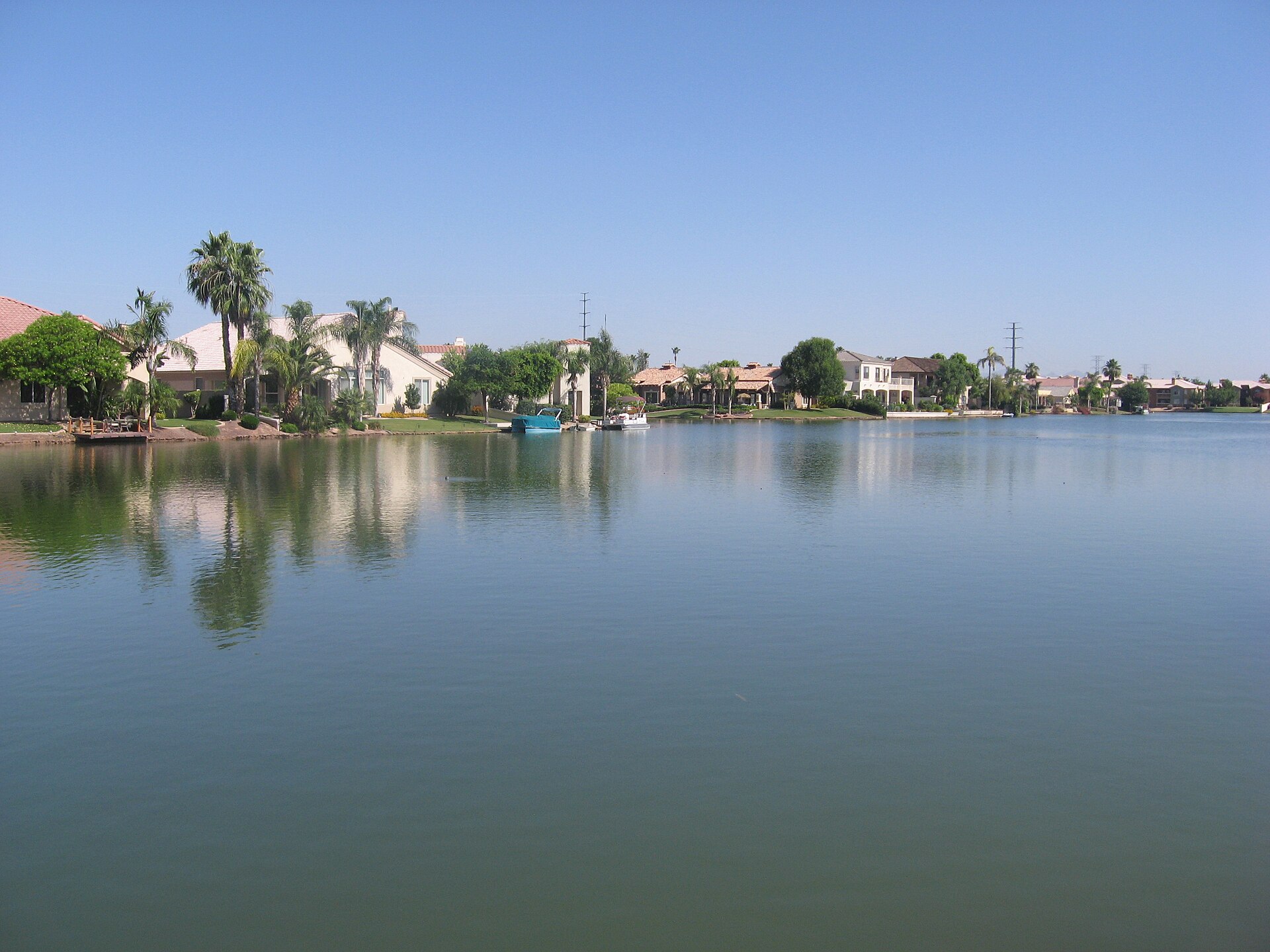
Photo: Eustress, Public domain, via Wikimedia Commons.