
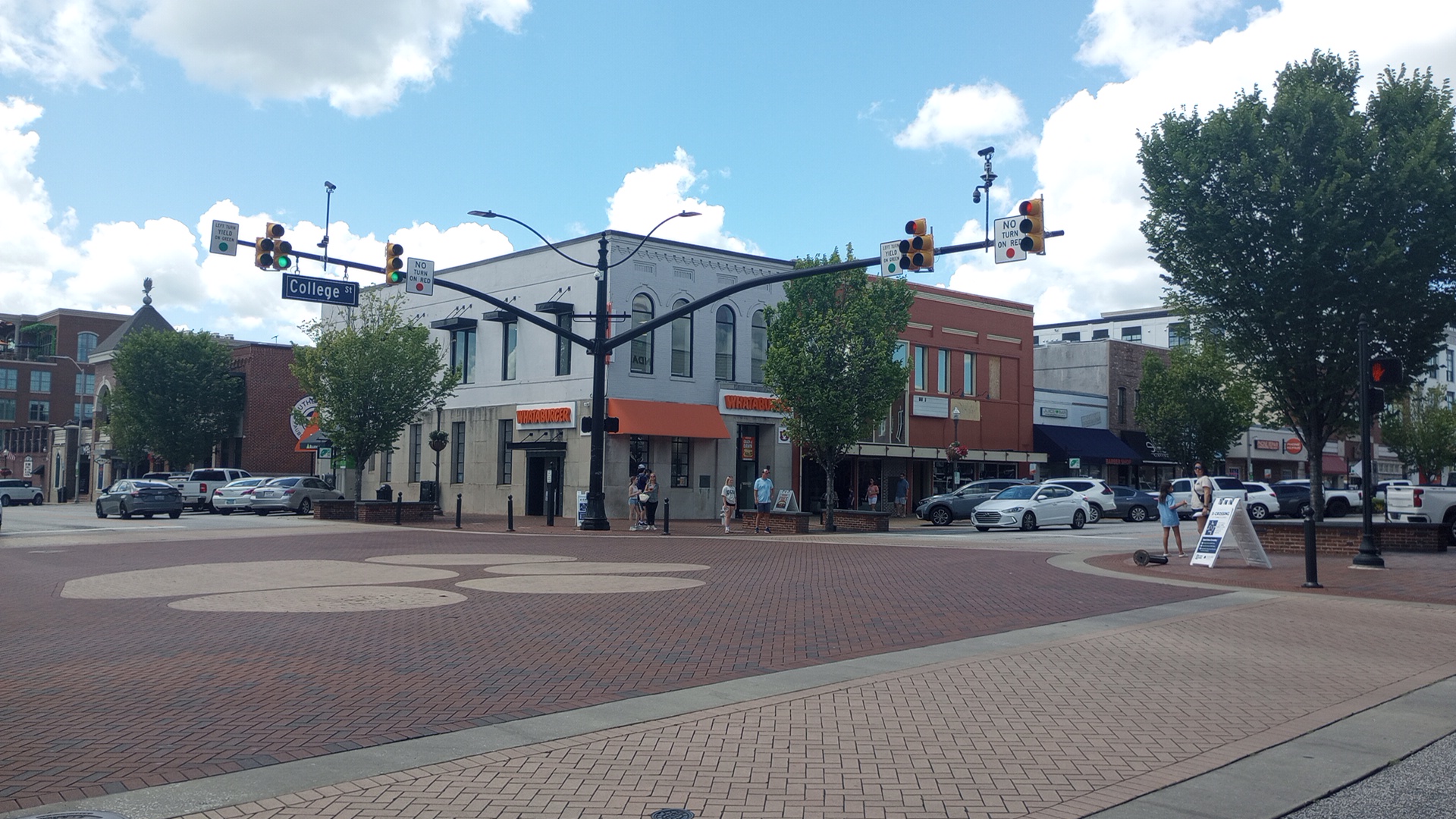
Auburn, AL Cost of Living in 2026: Rent and Homes
Auburn is a Lee County college town of 78,738 people where Auburn University, with 13,545 employees in 2024, drives the local economy and the rental market. Census estimates put the median gross rent at $1,034 a month and the median home value at $342,400. This guide breaks down housing, groceries, transportation, healthcare and entertainment costs, and how Auburn compares with Birmingham and Atlanta.
Located in Lee County in eastern Alabama, Auburn sits on I-85 about 90 minutes by car from the Atlanta airport. That corridor positioning matters more than people expect. It gives Auburn a rare combination of small-city quiet with genuine metro accessibility. The median age here is 25.6 years, which tells you almost everything about the vibe: young, student-heavy, restaurant-forward, and loud on fall Saturdays. The city’s 62.8% rate of residents holding a bachelor’s degree or higher shapes everything from the quality of the coffee shops to the political texture of local conversations.
Housing Costs: Renting and Buying in 2026
The Census Bureau’s 5-year estimates put Auburn’s median gross rent at $1,034 per month. That median reflects the full housing stock, including older units and graduate student apartments near campus.
The homeownership rate sits at 52%, which is surprisingly healthy for a university town where a large chunk of the population is transient by design. The Census-verified median home value is $342,400.
Looking Beyond Auburn
- Opelika (adjacent city): Prices drop noticeably in neighboring Opelika. Census estimates for 2019 to 2023 put Opelika’s median home value at $213,700, compared with $342,400 in Auburn. If you’re budget-constrained and car-dependent anyway, it’s worth looking seriously.
One honest caveat on buying: the poverty rate in Auburn is 26.1%, which is high for a city with this education profile. That figure is largely driven by student poverty (grad students, undergrads on limited income), but it also signals that the local workforce income and housing price gap is real. The median household income of $56,123 per year means a family at that income level, following a standard 28% housing ratio, can comfortably afford about $1,300 per month in housing costs. At $342,400 median home value, first-time buyers need either a strong down payment or a dual income. The math is tight but doable.
Food and Groceries
Auburn has a Kroger and an Aldi, so you’re not limited to one option.
Dining out is where Auburn surprises people. Because the student population demands affordable options, the city punches above its weight. The everyday rotation of spots near Toomer’s Corner and along College Street keeps prices competitive, and sit-down options include Acre on East Glenn Avenue.
One underappreciated cost: the food scene gets very crowded on home game weekends.
Transportation
Auburn is car-dependent. There is no regional rail, no commuter bus system worth relying on for most trips, and the Tiger Transit system primarily serves the university campus. If you live near downtown and work near campus, you can bike or walk. For everyone else, a car is not optional.
The Atlanta airport (northeast on I-85, about a 90-minute drive) is the practical airport for Auburn residents. Hartsfield-Jackson is one of the busiest airports in the world, which means flight options are excellent. There is daily ground transportation between Auburn and the Atlanta airport.
Healthcare
East Alabama Medical Center (EAMC) in neighboring Opelika, the flagship hospital of East Alabama Health, is the primary hospital serving Auburn and Opelika. It is licensed for 316 general acute care beds and 20 geriatric psychiatry beds and serves an 11-county area. For specialized or complex care, the nearest larger cities are Birmingham, about two hours away, and Atlanta.
Auburn University employees are covered through the university’s own AU Health Plan.
The Auburn University campus is also home to the Harrison College of Pharmacy.
Entertainment and Lifestyle
Auburn’s entertainment calendar is genuinely good for a city its size, and almost all of it is affordable. The Auburn University campus itself functions as a public amenity: art galleries, lectures, performances at the Gogue Performing Arts Center, and miles of greenspace. Chewacla State Park on the south edge of town offers hiking and the 26-acre Lake Chewacla, with entrance at $5 per person for ages 12 to 61 and $3 for children 4 to 11 and seniors 62 and up.
The bar scene around Toomer’s Corner is lively on weekends, especially in fall.
The honest downside to entertainment here is the ceiling. There’s no professional sports team, no major concert arena, and the main art museum is The Jule Museum at Auburn University (formerly the Jule Collins Smith Museum of Fine Art), an accredited campus museum. Big touring acts don’t stop in Auburn. If nightlife diversity or cultural programming matters to you, you will supplement Auburn with day trips to Atlanta.
How Auburn Compares: Birmingham and Atlanta
Auburn’s two relevant comparison cities are Birmingham, about two hours away by car, and Atlanta, about 90 minutes to its airport. Both offer larger labor markets and cultural infrastructure.
Birmingham: Census estimates for 2019 to 2023 put Birmingham’s median gross rent at $1,047 a month, close to Auburn’s $1,034. Birmingham’s median home value, $138,600, trails Auburn’s, and the job market in banking, healthcare, and finance is far deeper. If you work remotely, Auburn wins on quality of life. If you need an in-person career, Birmingham offers more runway.
Atlanta: Census estimates for 2019 to 2023 put the city of Atlanta’s median gross rent at $1,617 a month and its median home value at $420,600. Auburn’s $342,400 median looks excellent in contrast, especially given the pace of life difference. The tradeoff is Atlanta’s economic scale. It’s simply a different employment tier, particularly in tech, logistics, and finance.
The summary is this: Auburn is cheaper than Atlanta on housing by a significant margin, close to Birmingham on rent but higher on home values, but with a narrower job market focused heavily on Auburn University, healthcare, and mid-sized manufacturing.
The Real Pros and Cons
Pros
- Housing costs that are genuinely manageable. A median rent of $1,034 per month is rare for a city with this level of education attainment and amenity density.
- High walkability and bikability in the central core near campus.
- Excellent outdoor access (Chewacla State Park and Tuskegee National Forest nearby).
- Low property taxes by national standards. Alabama’s effective property tax rate is among the lowest in the country, 0.37% of home value in 2024 according to the Tax Foundation, second lowest among the states, and 0.39% in Lee County.
- Atlanta is close enough for airport access and city trips without city costs.
- The university keeps the food, arts, and event scene strong year-round.
Cons
- The 26.1% poverty rate reflects a real income gap in the community, one that coexists somewhat awkwardly with a $342,400 median home value.
- Fully car-dependent outside the campus core.
- Job market is narrow. Outside Auburn University, East Alabama Health, and local manufacturing, professional career options are limited.
- Football season transforms the city in ways that are genuinely disruptive if you are not a fan. Traffic, noise, and parking become serious issues on home game weekends.
- Summer heat and humidity are punishing. Summers are long, hot and humid: July highs average about 91 degrees, and a typical year has about 57 days at 90 degrees or above. This is Alabama.
Who Auburn Is Actually Right For
The remote worker seeking affordability near Atlanta. If your employer is in Atlanta but your presence is optional, Auburn is a compelling arbitrage. You get housing that costs less than in the city of Atlanta, a slower pace, and an easy highway shot to the city when you need it. The I-85 corridor makes this work practically.
Auburn University faculty, staff, and graduate students. This is the most obvious fit, but worth stating plainly. The university’s AU Health Plan, walkable campus proximity, and community built around academic rhythms make Auburn an unusually coherent place to build a career if you’re in higher education. The median income of $56,123 is livable here in a way it wouldn’t be in Atlanta or Nashville.
Young families prioritizing schools and space over urban access. Auburn City Schools, a district separate from Lee County Schools, runs 14 campuses with more than 9,400 students and says its schools consistently rank among the top in the state. If your priority is a good school district and a manageable mortgage, this fits.
Retirees downsizing from larger metros. Auburn’s medical infrastructure (anchored by East Alabama Medical Center), low property taxes, and genuinely lively cultural scene thanks to the university make it underrated for active retirees. Someone selling a home in Atlanta or Nashville can often buy in Auburn outright, eliminating a mortgage entirely. That’s a significant quality-of-life shift on a fixed income.
The Bottom Line
Auburn in 2026 is a genuinely affordable small city with some real structural advantages and a few honest constraints. A $342,400 median home value still leaves room for first-time buyers who plan ahead. The 26.1% poverty rate is a reminder that not everyone in Auburn is thriving, and that the gap between the university economy and the broader community is a real civic tension worth understanding before you arrive.
If you need a large, diverse job market, go to Atlanta or Birmingham and visit Auburn on game day. But if you can work remotely, work for the university, or are ready to build something in a city where your dollar stretches and your commute is short, Auburn earns serious consideration. It’s not perfect. No place is. But it’s specific, it’s livable, and it’s genuinely cheaper than most places with this much going on.
Frequently Asked Questions
What is the average rent in Auburn, AL in 2026?
Is Auburn, AL a good place to live for families?
How does the cost of living in Auburn, AL compare to Atlanta, GA?
What is the median household income in Auburn, AL?
Do you need a car to live in Auburn, AL?
Sources & methodology. Demographic and economic figures in this guide are drawn from the U.S. Census Bureau, 2019 to 2023 American Community Survey 5-Year Estimates. A newer 2020 to 2024 release came out on January 29, 2026; this guide still uses the 2019 to 2023 figures. Other figures come from the sources named next to them.
Last reviewed September 2026.
How this guide was made. Figures come from the U.S. Census Bureau ACS 2019 to 2023 5-year estimates and the other sources named next to each number. A first draft was written with the help of an AI language model; every place name, price, date and claim was then checked against primary sources by the Small City Guide editors (see About and Methodology). Last verified: September 26, 2026.
What changed: Fact-checked against primary sources in September 2026: 17 statements corrected, opening rewritten, photo replaced with a credited image of the city.
Photo: EulerianTrail, CC BY-SA 4.0, via Wikimedia Commons.